
Schon seit 2012 „Hubzilla, formerly Redmatrix, formerly red": Gruppen (Foren) und Tools für die gemeinsame Organisation
Veröffentlicht am 28. Juli 2026
Bereits seit seinem ersten Release im Juli 2012 lag der Schwerpunkt auf Community-Tools mit sozialen Funktionen.
Hubzilla sollte nie nur ein weiterer Stream sein, der um eure Aufmerksamkeit buhlt. Schon immer war es: Hubzilla für Communities. Ein Tool für Gruppen, die sich gemeinsam organisieren müssen, statt nur gegenseitig Beiträge zu posten. Schon immer verfügbar: Gruppen und Themen, Veranstaltungen, gemeinsame Organisationsprofile, einbettbare, föderierte Kommentare, anpassbare Designs und Governance-Tools. Es wurde als einsatzbereiter Raum mit allem, was dazugehört, bereitgestellt, der dann Block für Block neu gestaltet werden kann: Fügt hinzu, was fehlt, tauscht aus oder forkt, was fast passt, und deaktiviert, was ihr nicht braucht.
Warum die Gemeinschaft an erster Stelle steht
Als Hubzilla, das damals noch auf den Namen "red" hörte, im Juli 2012 veröffentlicht wurde, bot es eine ausgereifte, lokal verwaltete, föderierte Social-Media-App, in der die Nutzer ihre Streams, ihre Berechtigungen und den Kreis der Personen, die sie erreichen können, selbst kontrollieren.
Doch das soziale Netzwerk war nur ein kleiner Teil eines wesentlich umfangreicheren Systems. Zwar gibt es schon seit Jahren Open-Source-Tools für Entscheidungsfindung, Veranstaltungen oder gegenseitige Hilfe, doch sie haben es schwer, weil sie abseits der Orte angesiedelt sind, an denen sich die Menschen gerne austauschen. Sind dieselben Tools stattdessen in einen sozialen Raum integriert -- neben den Menschen, denen du bereits folgst, deinen Gruppen und deinen Streams --, gewinnen sie genau jene alltägliche Anziehungskraft, die Gemeinschaften auf den großen Plattformen zusammenhält. Und diese Beziehungen gehören dir: Jedes Tool teilt sie, und sie begleiten dich durch das offene Web.
Vierzehn Jahre mit echten Gemeinschaften haben dies bestätigt. Niemand kam zu Hubzilla und bat um ein besseres Mikroblog. Sie kamen, weil sie ihrer Gemeinschaft ein Zuhause geben wollten. Ein Magazin, dessen Leser miteinander diskutieren wollten, nicht nur über die Artikel. Ein Netzwerk für psychische Gesundheit, das Räume brauchte, in denen Menschen sicher sprechen konnten. Eine Stadt, die ihre Veranstaltungen, ihre Ankündigungen und ihre Diskussionen an einem Ort haben wollte, der lokal verwaltet wird. In jedem Fall war der Stream der am wenigsten interessante Teil der Lösung.
Streams sind auf Einzelpersonen ausgerichtet: gut für Smalltalk und Entdeckungen, aber die falsche Form für die Organisation. Wenn bestimmte Personen etwas sehen, darauf reagieren und es weiterverfolgen sollen, braucht man eine Gruppe: mit Mitgliedschaft, mit Regeln, mit einem Kalender und einer Möglichkeit, gemeinsam Entscheidungen zu treffen.
Die Community stand schon immer im Mittelpunkt des Projekts.
Wichtigste Community-Funktionen
Diese Funktionen schon immer verfügbar: einsatzbereit und bereits in echten Communities im Einsatz, wobei Gruppen auch schon immer instanzübergreifend verbunden sind. Betrachtet dies als Einladung an weitere Communities, diese Bausteine so zu gestalten, wie es jeweils ihren tatsächlichen Bedürfnissen entspricht. Möchtet ihr es zuerst ausprobieren? Gruppen und alle anderen unten aufgeführten Funktionen sind auf jeder Instanz (Hub), verfügbar.
Gruppen (Foren) und Themen (Kategorien)
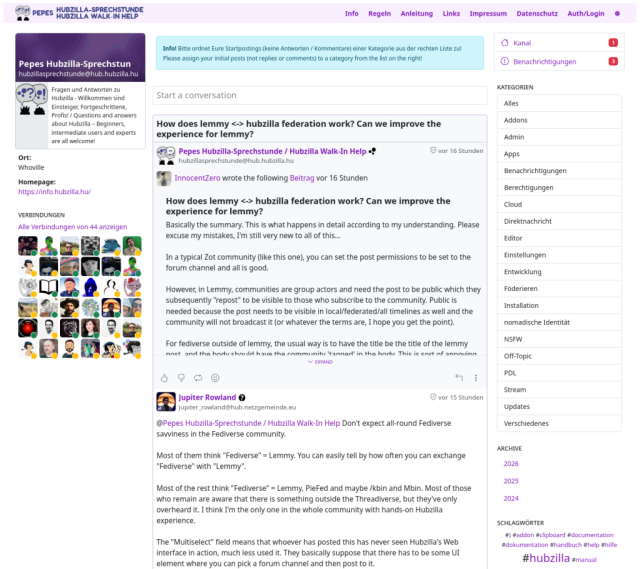
Bei Hubzilla sind Gruppen, die Foren genannt werden, Räume, in denen Communities, Organisationen und Teams ihre eigene Mitgliedschaft, Berechtigungen und Regeln festlegen können. Da sie auf unserem flexiblen Berechtigungssystem basieren, kann ein Forum jede beliebige Form annehmen: Ihr könnt ein öffentliches Forum betreiben, einen Raum nur für Ankündigungen, einen privaten Raum nur auf Einladung oder ein Forum, die nur für einen bestimmten Kreis sichtbar ist. Ihr könnt eure Meinung später jederzeit ändern, wenn sich das Forum weiterentwickelt.
Zudem gibt es innerhalb der Gruppen Themen, die Kategorien genannt werden, welche verhindern, dass Unterhaltungen in einem undifferenzierten Stream untergehen. Du kannst einem Forum folgen oder eine einzelne Kategorie filtern, sodass Aktualisierungen in deinem Stream erscheinen, ohne dass du jede Forenseite besuchen musst, um zu prüfen, ob es etwas Neues gibt.
Community-Regeln
Jeder Raum braucht gemeinsame Erwartungen. Sowohl Server als auch einzelne Gruppen können ihre eigenen Community-Regeln festlegen, damit Neulinge wissen, in welche Art von Raum sie eintreten, und Moderatoren sich auf konkrete Vorgaben stützen können, anstatt Entscheidungen von Grund auf neu treffen zu müssen.
Entscheidungsfindung
Gemeinsame Entscheidungen zu treffen ist ein herausragendes Merkmal. Hubzilla verfügt über Entscheidungswerkzeuge, die von schnellen Umfragen bis hin zu umfangreichen Umfragen reichen, sodass Gruppen den für die jeweilige Entscheidung am besten geeigneten, möglichst einfachen Prozess nutzen können:
- Einfach- oder Mehrfachauswahl: vertraute Umfragen, bei denen die Teilnehmer einfach eine oder mehrere Optionen auswählen.
- Vorschlag und Konsens: für Entscheidungen, die vor einer Abstimmung diskutiert werden müssen, in Anlehnung an soziokratische Praktiken: Vorschläge sammeln, diskutieren und abändern, Einwände einbeziehen und dann weitermachen.
Veranstaltungen
Gemeinschaften leben von Zusammenkünften. Hubzilla umfasst Veranstaltungen mit Kalenderansichten, um zu sehen, was demnächst ansteht.
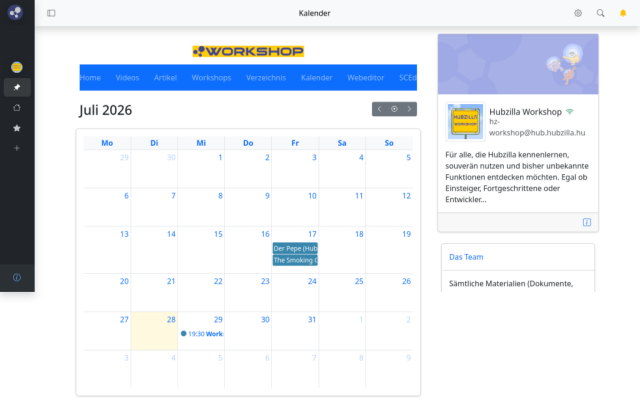
Hubzilla ist von Grund auf modular aufgebaut, und diese Modularität beschränkt sich nicht nur auf unsere eigenen Erweiterungen: Anstatt dem „Not-Invented-Here"-Syndrom zu erliegen, vernetzen wir uns mit speziellen Tools aus dem gesamten Ökosystem, sodass Veranstaltungen app-übergreifend veröffentlicht und entdeckt werden können, anstatt in einer einzigen App eingeschlossen zu sein. Hubzillas Event-Kalender sind durch andere Kalender-Apps abonnierbar.
Organisationsprofile
Eine Gemeinschaft besteht selten aus nur einer Person. Ihr könnt nun ein gemeinsames Organisationsprofil (eine Zeitschrift, ein Kollektiv, eine Arbeitsgruppe, ein Moderationsteam) erstellen, das von mehreren Konten gemeinsam verwaltet wird. Von außen sieht es aus wie jedes andere Profil: Es veröffentlicht Beiträge, man kann ihm folgen, und es ist als Organisaution vernetzt. Im Hintergrund können Menschen kommen und gehen, ohne dass jemand ein Passwort weitergeben muss.
Gemeinsame Cloud inklusive Collabora
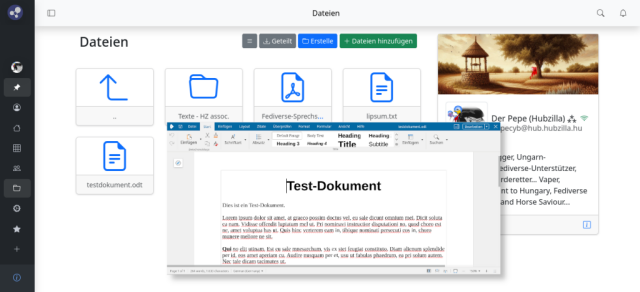
Häufig ist es notwendig, innerhalb einer Gemeinschaft Dokumente und Dateien auszutauschen. Hubzilla stellt Dir dafür eine integrierte vollwertige Cloud zur Verfügung. Für das komfortable Bearbeiten von Dokumenten kann Collabora Online integriert werden.
Und weil nicht jede Datei für jeden zugänglich sein muss, greift auch hier das Berechtigungssystem.
Wissens-Management mit dem Wiki
Häufig ist es sinnvoll, Informationen, eine Dokumentation oder Anleitungen für die Gemeinschaft zugänglich zu machen. Hubzilla bietet dafür ein klassisches Wiki, das selbstverständlich auch eine gemeinsame Bearbeitung erlaubt.
Ankündigungen
Wenn etwas alle Mitglieder erreichen soll (z. B. ein Abstimmungsvorschlag, eine Aktualisierung des Verhaltenskodexes, ein Aufruf zum Handeln), können Administratoren und Moderatoren eine Ankündigung veröffentlichen, die in den Benachrichtigungen jedes Mitglieds und als Push-Benachrichtigung erscheint, anstatt darauf zu hoffen, dass sie im Feed auftaucht.
Es sieht aus wie eure Community, nicht wie ein Standardprodukt oder die Plattform eines anderen
Hubzilla bietet verschiedene Designs, und ihr könnt eure eigenen erstellen, indem ihr Farben, Schriftarten und Layout anpasst, ohne Code schreiben zu müssen. Und es geht über ein einfaches Design hinaus: Eure Domain, euer Name, euer Kopfbanner, eure Typografie -- der gesamte Bereich wirkt wie euer eigener, ohne dass irgendetwas von uns zwischen euch und euren Mitgliedern steht. Selbst kommerzielle Community-Plattformen als Service gehen selten so weit.
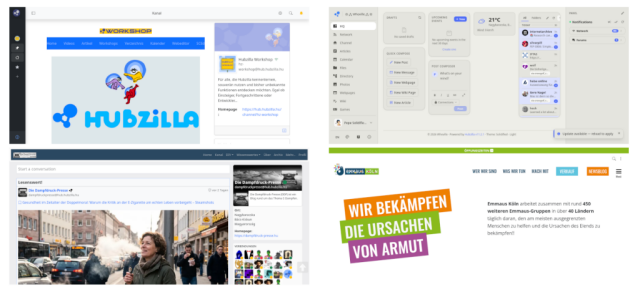
Wenn beispielsweise die Leser der Hubzilla-Association auf hubzilla.org gelangen, sehen sie die Seite der Association von Anfang bis Ende, ohne dass Anzeichen für eine andere Plattform im Hintergrund erkennbar sind. Das war ein so wichtiger Faktor, dass es ein Hauptgrund für die Wahl von Hubzilla war: Ein Community-Bereich sollte sich wie ihr eigener Raum anfühlen, nicht wie eine unsichere Ecke einer Plattform, über die sie keine Kontrolle haben.
Single Sign-On in beide Richtungen
Hubzilla unterstützt SSO mit OpenID und OAuth2 sowohl als Client als auch als Provider: Mitglieder können sich mit einem bereits bestehenden Konto anmelden, oder Hubzilla kann selbst als Identitätsanbieter fungieren, der sie bei anderen Apps anmeldet. Eine Hürde weniger beim Beitritt und ein Passwort weniger, das verwaltet werden muss.
Schnell und zuverlässig
Hubzilla ist von je her schnell und zuverlässig, und die Hauptentwickler arbeiten beständig daran es weiter zu optimieren. Ein Hubzilla Hub kann sogar auf einem Raspberry Pi betrieben werden!
Wie geht es weiter?
Hubzilla wird, wie schon immer, kontinuierlich weiterentwickelt. Aktuell befindet sich Hubzilla v. 11.4RC2 in der öffentlichen Testphase.
Probiert es aus
Hubzilla ist freie Software unter der MIT-Lizenz, ohne Investoren, ohne Werbung und ohne Werbegeschäft, das später erst aktiviert werden soll. Ihr könnt eine Instanz installieren oder Euch bei einem öffentlichen Hub anmelden.
Diese Arbeit lebt von der Unterstützung der Community. Wenn ihr wollt, dass sie weitergeht, könnt Ihr das Projekt unterstützen.
Ihr findet uns hier: https://hubzilla.org.
FAQ
Warum betreibt ihr keine öffentliche Flaggschiff-Instanz?
Weil wir ein Ökosystem wollen: Hosting, Governance, Moderation und Einnahmen, die auf viele Genossenschaften und Gemeinschaften verteilt sind, von denen jede ihren eigenen Mitgliedern Rechenschaft ablegt -- statt des Standardmodells „Der Gewinner bekommt alles", bei dem die Entwickler der Software zu Vermietern für alle werden, ihre Flaggschiff-Instanz die Roadmap bestimmt, das Netzwerk standardmäßig moderiert und die Hosting-Gebühren aller einzieht.
Disclaimer
Ähnlichkeiten mit lebenden oder toten Personen oder alten oder ganz neuen Fediverse-Projekten und veröffentlichen Texten sind mal voll fett total zufällig und ganz ehrlich auch nicht beabsichtigt! 😉
Hubzilla - Niemand muss das Rad neu erfinden!
Since 2012 "Hubzilla, formerly Redmatrix, formerly red": Groups (forums) and tools for collaborative organisation
Published on 28 July 2026
Ever since its first release in July 2012, the focus has been on community tools with social features.
Hubzilla was never meant to be just another feed vying for your attention. It has always been: Hubzilla for communities. A tool for groups that need to organise themselves collectively, rather than just posting to each other. Always available: groups and topics, events, shared organisational profiles, embeddable, federated comments, customisable designs and governance tools. It was provided as a ready-to-use space with everything you need, which can then be redesigned block by block: add what's missing, swap out or fork what almost fits, and disable what you don't need.
Why the community comes first
When Hubzilla -- then still known as 'red' -- was released in July 2012, it offered a fully-fledged, locally managed, federated social media app in which users themselves controlled their feeds, their permissions and the circle of people they could reach.
But the social network was only a small part of a much more extensive system. Although open-source tools for decision-making, organising events or mutual support have been around for years, they struggle because they're located away from the places where people like to interact. If, instead, these same tools are integrated into a social space -- alongside the people you already follow, your groups and your feeds -- they gain precisely the everyday appeal that holds communities together on the major platforms. And these relationships belong to you: every tool shares them, and they accompany you across the open web.
Fourteen years of real communities have confirmed this. Nobody came to Hubzilla asking for a better microblog. They came because they wanted to give their community a home. A magazine whose readers wanted to discuss things with one another, not just the articles. A mental health network that needed spaces where people could speak safely. A town that wanted its events, announcements and discussions in one place that was managed locally. In every case, the stream was the least interesting part of the solution.
Streams are geared towards individuals: good for small talk and discovery, but the wrong format for organisation. If specific people are to see something, react to it and follow it up, you need a group: with membership, with rules, with a calendar and a way to make decisions together.
The community has always been at the heart of the project.
Key community features
These features have always been available: ready to use and already in use within real communities, with groups having always been connected across instances. Please regard this as an invitation to other communities to customise these building blocks to suit their specific needs. Would you like to give it a go first? Groups and all the other features listed below are available on every instance (hub).
Groups (forums) and topics (categories)
On Hubzilla, groups, known as forums, are spaces where communities, organisations and teams can define their own membership, permissions and rules. As they are based on our flexible permissions system, a forum can take any form: you can run a public forum, a space for announcements only, a private space accessible by invitation only, or a forum visible only to a specific group. You can change your mind at any time later on as the forum evolves.
In addition, within the groups there are topics, known as categories, which prevent conversations from getting lost in an undifferentiated stream. You can follow a forum or filter by a single category, so that updates appear in your stream without you having to visit every forum page to check if there's anything new.
Community rules
Every space needs shared expectations. Both servers and individual groups can set their own community rules so that newcomers know what sort of space they're entering, and moderators can rely on specific guidelines rather than having to make decisions from scratch.
Decision-making
Making decisions together is a standout feature. Hubzilla offers decision-making tools ranging from quick polls to comprehensive surveys, allowing groups to use the simplest process best suited to each decision:
- Single or multiple choice: familiar polls where participants simply select one or more options.
- Proposal and consensus: for decisions that need to be discussed before a vote, based on sociocratic practices: gather proposals, discuss and amend them, incorporate objections, and then move forward.
Events
Communities thrive on get-togethers. Hubzilla includes events with calendar views so you can see what's coming up.
Hubzilla is built from the ground up to be modular, and this modularity isn't limited to our own extensions: rather than succumbing to the 'Not Invented Here' syndrome, we integrate with specialised tools from across the ecosystem, so that events can be published and discovered across apps, rather than being confined to a single app. Hubzilla's event calendars can be subscribed to via other calendar apps.
Organisational profiles
A community rarely consists of just one person. You can now create a shared organisational profile (a magazine, a collective, a working group, a moderation team) that is jointly managed by multiple accounts. From the outside, it looks like any other profile: It publishes posts, you can follow it, and it's networked as an organisation. Behind the scenes, people can come and go without anyone having to share a password.
Shared cloud including Collabora
It's often necessary to share documents and files within a community. Hubzilla provides you with a fully-fledged, integrated cloud for this purpose. Collabora Online can be integrated for convenient document editing.
And because not every file needs to be accessible to everyone, the permissions system applies here too.
Knowledge management with the wiki
It is often useful to make information, documentation or instructions available to the community. Hubzilla offers a classic wiki for this purpose, which of course also allows collaborative editing.
Announcements
If something needs to reach all members (e.g. a voting proposal, an update to the code of conduct, a call to action), administrators and moderators can publish an announcement that appears in every member's notifications and as a push notification, rather than hoping it will turn up in the feed.
It looks like your community, not like a off-the-shelf product or someone else's platform
Hubzilla offers various designs, and you can create your own by customising colours, fonts and layout without having to write any code. And it goes beyond a simple design: your domain, your name, your header banner, your typography -- the entire site feels like your own, with nothing from us standing between you and your members. Even commercial community platforms-as-a-service rarely go this far.
For example, when readers of the Hubzilla Association visit hubzilla.org, they see the Association's site from start to finish, with no signs of another platform visible in the background. This was such an important factor that it was a key reason for choosing Hubzilla: a community space should feel like their own space, not like a precarious corner of a platform over which they have no control.
Two-way single sign-on
Hubzilla supports SSO with OpenID and OAuth2 both as a client and as a provider: members can log in using an existing account, or Hubzilla itself can act as an identity provider to log them into other apps. That's one less hurdle to joining and one less password to manage.
Fast and reliable
Hubzilla has always been fast and reliable, and the core developers are constantly working to optimise it further. A Hubzilla hub can even be run on a Raspberry Pi!
What's next?
Hubzilla is, as always, undergoing continuous development. Hubzilla v. 11.4RC2 is currently in the public testing phase.
Give it a go
Hubzilla is free software under the MIT licence, with no investors, no adverts and no advertising model to be activated at a later date. You can install an instance or sign up to a public hub.
This work relies on the support of the community. If you want it to continue, you can support the project.
You can find us here: https://hubzilla.org.
FAQ
Why don't you run a public flagship instance?
Because we want an ecosystem: Hosting, governance, moderation and revenue distributed across many co-operatives and communities, each of which is accountable to its own members -- rather than the standard 'winner-takes-all' model, where the software developers become landlords for everyone, their flagship instance dictates the roadmap, moderates the network by default and collects hosting fees from everyone.
Disclaimer
Any similarities to living or deceased persons, or to old or brand-new Fediverse projects and published texts, are totally, completely coincidental and, quite honestly, not intended! 😉
Hubzilla -- Nobody needs to reinvent the wheel!


Join Hubzilla
joinhubzilla@hub.hubzilla.hu
Steigen Sie ein in die vielfältige Welt von Hubzilla!